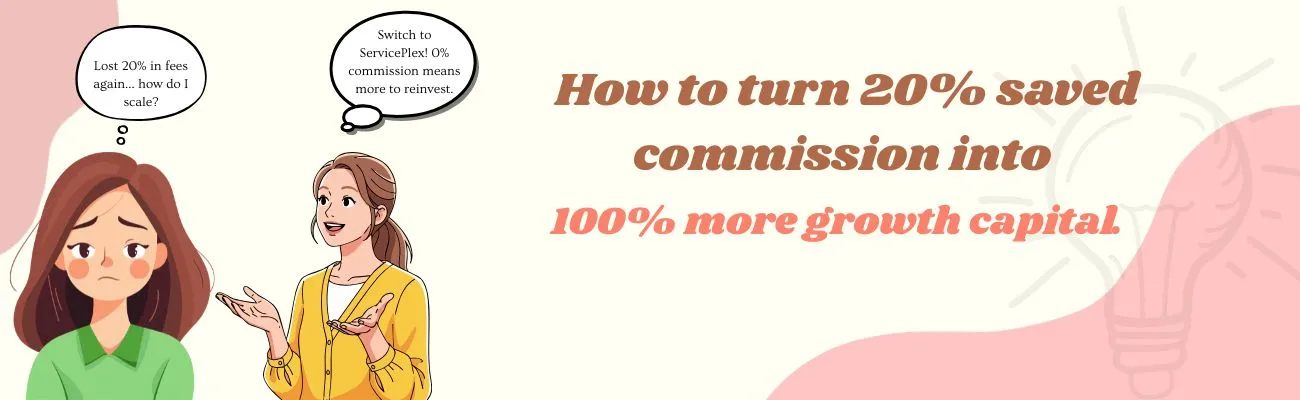
How to Reinvest Your Saved Commission to Grow Your Service Business
The Silent Tax That’s Quietly Capping Your Growth
Most service-based business owners who offer services often overlook a structural drawback. When you work through traditional marketplaces that charge 10-2-% per project, you're not simply paying for visibility. You're paying a scale tax on itself.
Whenever you finish up with a ₹1,00,000 project and lose ₹20,000 to commission, that money doesn't just disappear; it takes away your power to invest in better systems, better positioning, and direct client acquisition. Over twelve months, such deductions compound into lakhs of lost growth capital.
This forms the Survival Loop. You work hard, achieve results, pay money, keep the money moving, and do it again. The company survives, but it rarely expands strategically.
Compare it now with Growth Loop. You shut down the same project and keep the entire margin and reinvest the savings in automation, authority, and marketing. You finance your own platform instead of funding a platform's expansion.
That's the actual benefit of working in a zero-commission marketplace such as ServicePlex. It's not just about avoiding fees. It's about reclaiming capital and using it deliberately to generate the scalability of the real service business.
The ServicePlex Multiplier: Why 20% Saved Is More Powerful Than It Sounds
On the surface level, removal of a 20% commission will be a simple margin growth. However, the impact is much more significant in terms of money.
Suppose your annual revenue is ₹10,00,000, and after deducting expenses, you retain ₹2,00,000 as profit. If you were paying ₹2,00,000 in platform commissions, eliminating this expense will not raise your bottom line by even a single dollar; it will increase your retained capital. Your reinvestment capital increases by 100%.
This is the ServicePlex Multiplier. When baseline margins are less than aggressive, removing commissions dramatically expands your strategic options. What was once barely enough to sustain operations becomes meaningful fuel for growth experiments, brand building, and automation updates.
The key question is Will you use the saved commission as additional profit or as structured growth capital?
Level 1: Strengthen Your Tech Stack to Buy Back Time
Leverage should always come first as a priority of reinvestment. Time is your most limited asset and automation is the quickest way to the optimum profit margins.
Reinvesting saved commission into better systems immediately expands capacity without increasing workload. Automation platforms like Zapier can connect your CRM, involving system, email marketing, and lead forms so that repetitive tasks run automatically. Premium AI tools help to minimize the time spent on proposal creation and enhance the level of research. Upgraded, enhanced systems increase follow-up consistency and close rates.
The compounding effect is powerful. If better systems save you ten hours per week, that’s roughly forty hours per month. In a service business, forty additional hours often translates into an extra client project. The commission savings fund the tools. The tools create capacity. Capacity generates revenue. Revenue expands reinvestment potential.
This is how a service provider starts to think like a system builder rather than a task executor.
Level 2: Invest in Authority to Increase Pricing Power
Tools increase output, but authority increases revenue per unit of output.
Many freelancers struggle with rate resistance because they compete on execution. The most profitable agencies and consultants differentiate through insight density — unique frameworks, deep specialization, and advanced understanding of industry problems.
When you reinvest your Growth Fund into high-level certifications, private masterminds, industry research, or elite mentorship, you increase your Information Gain. You begin offering strategic direction, not just implementation.
As authority rises, several things happen simultaneously. Close rates improve because clients perceive greater expertise. Sales conversations shorten because trust is established faster. Price objections decrease because value perception increases.
This is where true agency growth strategy emerges. Higher positioning supports higher rates. Higher rates increase the margin. Increased margin fuels further reinvestment.
Level 3: Build Direct Marketing and Reduce Platform Dependency
Platforms can be useful discovery channels, but dependency limits control. When your entire pipeline depends on an algorithm or marketplace ranking, your growth remains externally governed.
Reinvesting saved commission into direct B2B lead generation changes that equation. LinkedIn advertising, Sales Navigator subscriptions, premium outreach software, and content production systems allow you to create consistent direct client connection channels.
Instead of waiting for leads, you initiate conversations. Instead of competing in crowded bidding environments, you approach prospects with positioning already established. Over time, this transition reduces vulnerability and increases predictability.
This is how service businesses achieve real scalability. They move from marketplace participation to distribution ownership.
The 50/30/20 Reinvestment Structure
Growth requires structure. Without intentional allocation, saved commission can easily be absorbed into operational noise.
A practical approach is the 50/30/20 model. Allocate fifty percent of saved commission toward outward growth activities such as paid acquisition and brand visibility. Dedicate thirty percent toward internal capability — automation tools, AI systems, or advanced training. Preserve twenty percent as strategic reserve capital for hiring experiments, unexpected opportunities, or market shifts.
This balance ensures forward motion without destabilizing cash flow.
Auditing Your Platform Loss
Before making any structural shift, calculate your true opportunity cost. Review your last twelve months of platform revenue and determine exactly how much was paid in commissions. Then ask a more important question: what could that capital have built?
Could it have funded six months of targeted LinkedIn ads? Could it have paid for automation systems that saved dozens of hours monthly? Could it have positioned you as a category expert through premium education?
Most service providers underestimate cumulative commission impact because they view fees transactionally rather than strategically. When you annualize the numbers, the scale becomes undeniable.
The Psychological Shift: From Gig Worker to Service CEO
The financial mechanics matter, but the mindset shift matters more.
Gig workers optimize for project flow. Service CEOs optimize for capital allocation. Gig workers focus on the next invoice. Service CEOs focus on margin structure and distribution control.
Operating inside a zero-commission marketplace encourages this transformation. When you retain full revenue, you begin thinking in terms of reinvestment cycles rather than immediate payouts. Every project becomes a growth event, not just income.
That shift from reactive earning to proactive scaling is what ultimately determines long-term success.
Commission savings are not extra profit. They are undeployed growth capital.
Inside a zero-commission marketplace like ServicePlex.in, that capital remains under your control. When strategically reinvested into automation, authority, and direct marketing, it becomes the engine of service business scalability.
The choice is simple. Continue funding the Survival Loop, or activate the Growth Loop and compound your advantage.
Published on 19 Feb, 2026
·
435 views
Put this into practice on ServicePlex
Find freelancers and businesses to work with, or list your own services — contact is direct and there's no commission.